

Choosing the right trailer depends on several factors, including load capacity, towing requirements, and how you plan to use it. Both gooseneck and bumper pull trailers offer advantages, but understanding their differences can help you make an informed decision.
At PJ Trailers Canada, we help customers find trailers that are suited to their hauling needs. This blog compares five important factors to consider when choosing between a gooseneck and bumper pull trailer.
1. LOAD SIZE
Bumper pull trailers (like those made by LWL and Lightning Trailers) are a convenient option for transporting smaller loads. They connect to a hitch at the rear of the towing vehicle, making them suitable for a wide range of hauling applications.
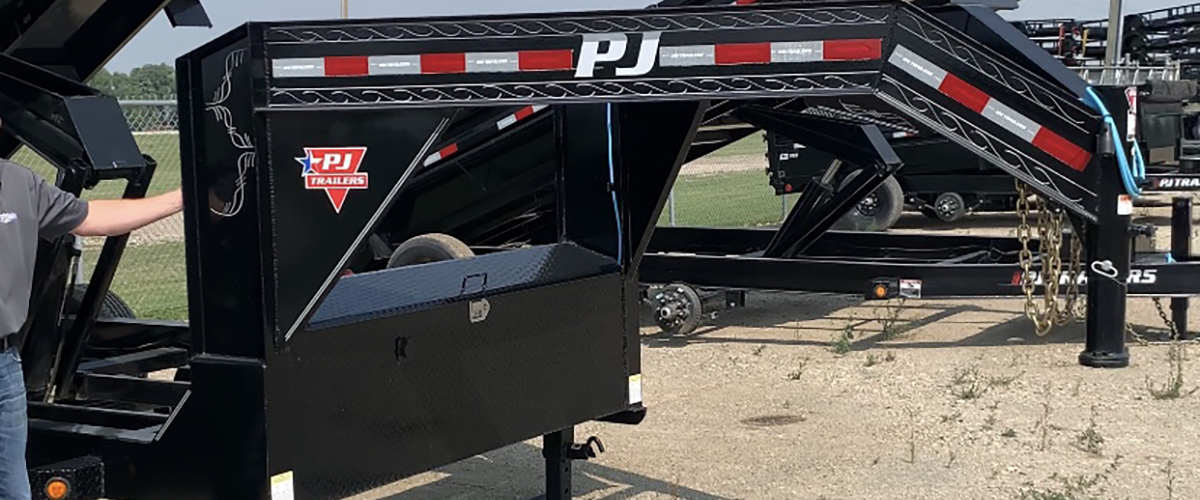
Gooseneck trailers are often preferred for heavier loads and demanding hauling requirements. Unlike bumper pull trailers, gooseneck trailers connect to a hitch positioned in the truck bed, near or slightly ahead of the rear axle.
This configuration can provide several advantages, including improved weight distribution, greater towing stability, and better handling when transporting heavy loads.
One of the main benefits of a gooseneck trailer is its weight distribution. With a bumper pull trailer, the hitch weight is supported behind the truck’s rear axle. A gooseneck trailer positions this weight closer to the axle, allowing the truck to distribute the load more effectively.
When properly matched to the towing vehicle and loaded within its rated capacity, this can contribute to:
- Better fuel efficiency, depending on the load, trailer design, and driving conditions.
- Less wear on the truck by reducing unnecessary strain from improper weight distribution.
- A smoother ride with improved stability and reduced trailer sway.
2. SHORT TRAVEL OR LONG ONE
The distance and frequency of your trips can affect which trailer best suits your needs.
Bumper pull trailers are a practical choice for local deliveries, construction projects, landscaping work, and general transportation. Their accessibility and straightforward hitching systems make them convenient for everyday use.
Gooseneck trailers (like those offered by Ironbull, K-Trail, and Kauffman) are commonly used for frequent hauling and long-distance transportation.
When travelling long distances with heavy loads, gooseneck trailers can offer greater towing stability.
Because bumper pull trailers connect behind the towing vehicle’s rear axle, improper weight distribution can contribute to trailer sway, making the combination harder to control.
Gooseneck trailers connect near the truck’s rear axle, which can help reduce sway and improve stability when travelling at highway speeds or navigating winding roads.
Both trailers can be used safely for long-distance towing when properly equipped, loaded, and operated within their rated capacities.
3. THE TYPE OF MATERIALS WHICH YOU HAUL
The materials and equipment you transport are important considerations when selecting a trailer.
Bumper pull trailers are best for many everyday hauling tasks, including transporting soil, gravel, landscaping materials, construction debris, and other bulk products. They can be a practical option for smaller loads and businesses that regularly transport similar materials.
They also offer greater flexibility for loads that vary in weight, size, or shape, as long as the cargo fits within the trailer’s dimensions.
The right choice depends on your materials’ weight and volume, how often you haul them, and the trailer’s specifications.
4. KIND OF TRUCK WHICH YOU HAVE
Before choosing a trailer, consider your vehicle’s towing capabilities.
Bumper pull trailers are vehicle compatible, connect to the trailer hitch, and can be towed by any truck with the appropriate towing capacity.
Gooseneck trailers are attached directly to the truck bed and you:
-
- lose the use of your box or bed
- need a truck that can handle a gooseneck (usually a ¾ or 1 ton) and has a built-in gooseneck hitch.
5. PARKING AND MANEUVERS
Parking, reversing, and navigating tight spaces are additional factors to consider.
Bumper pull trailers often offer a shorter overall trailer length and greater compatibility with different towing vehicles.
Gooseneck trailers require a compatible vehicle equipped with a specialized hitch.
Experienced drivers may find gooseneck trailers easier to maneuver in certain situations because the hitch connection sits in the truck’s bed rather than behind the rear bumper.
Another advantage is the potential for tighter turning angles. Depending on the vehicle and trailer configuration, some gooseneck trailers can achieve turning angles approaching 90 degrees, providing greater flexibility when maneuvering in confined spaces.
This flexibility can help when navigating tight spaces, job sites, or areas with limited room to maneuver.